
with Yuri Frolov
YF: Thank you so much for joining me today. To begin, could you briefly introduce your background?
FT: Thanks for having me and giving me the opportunity to talk about our work. My academic background is in art history and cultural history. I earned my PhD at SOAS, University of London, focusing on Myanmar. Over the past 20 years, I’ve been involved in academic exchange and project coordination in both Cambodia and Myanmar. I’ve now been based in Myanmar for more than 15 years.
YF: Could you tell us about the Inya Institute, the organization you represent?
FT: The Inya Institute is a research center dedicated to promoting academic exchange between Myanmar and international scholars. We focus on fostering scholarship about Myanmar’s history, culture, and society in all its diversity—including the many ethnic groups in the country. Our goal is to build programs that reflect both local and global academic perspectives. The institute began in 2014 and was formally registered in Myanmar in 2020.
YF: Let’s talk about the upcoming language courses, which I find fascinating. I studied at SEASSI at the University of Wisconsin–Madison last year. That program didn’t offer any minority languages from Myanmar—only Burmese. I remember a Karen American student in the Burmese class who really wanted to study her heritage language but couldn’t. Your program seems quite different. First, the program offers online instruction for each language; second, it includes courses in Karen, Kachin, and Shan. What motivated the decision to focus on these lesser-taught languages?
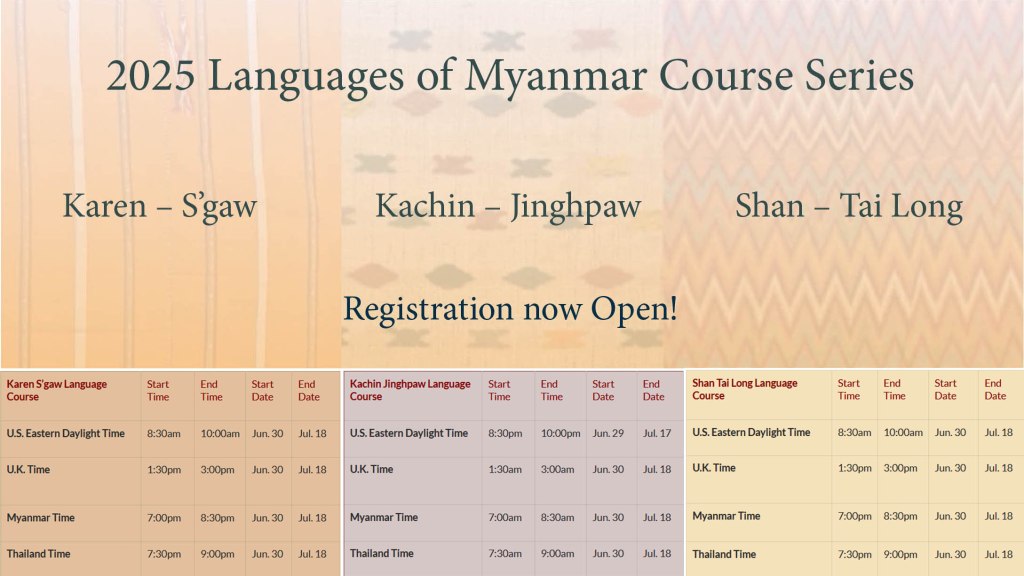
FT: That’s a great question. Burmese language courses are fairly well-established at institutions like Cornell, UC Berkeley, Northern Illinois University, and Australian National University. But there has been much less attention to non-dominant languages—Myanmar’s many ethnic languages. Our idea was to fill that gap and offer both Myanmar speakers and international learners a chance to study these languages, including Karen, Shan, and Kachin.
Our aim with the course is to foster mutual interest and respect among Myanmar’s diverse communities, especially in today’s difficult political climate. It’s also a way for Burmese speakers to engage with other ethnic cultures within their own country, and to do so directly, without having to go through English.
We’ve welcomed participants from the U.S., Japan, Europe, and the UK. Some are NGO workers, others are scholars, librarians, or members of the diaspora. Many are looking to connect with communities they work with or study. For example, last year we had a Karen-American student from North Carolina who wanted to improve her reading and writing in Karen to better engage with her community. We’re also trying to connect with diasporic communities in the U.S., Canada, and the UK.
Here everyone can register for the course: https://www.inyainstitute.org/2025-languages-of-myanmar-course-series/?fbclid=IwY2xjawK3NbNleHRuA2FlbQIxMABicmlkETFUR2RwUUswRzFIUVFyNnV3AR54qDd4pMoYO7yZywwuC51HEW0uJ4zhs7D2ARoLKjYDyy3ofbpc0GIC8M6n7w_aem_ulrWILgB6JVodHngtAP7Gg
YF: That’s fantastic. Could you share more about the course structure and instructors?
FT: We launched the course in 2022, so this summer will mark the fourth iteration. We had two experienced Burmese language instructors train our ethnic language instructors. One is now based in Paris, and the other is teaching at Cornell. They helped shape our teaching methods and ensured that our instructors followed international best practices in language teaching.
Although our course is shorter—just three weeks compared to SEASSI’s 8-week program—it’s intensive. We offer about 1.5 hours of instruction per day, along with substantial daily homework. Despite the rather short duration, feedback from participants has been overwhelmingly positive.
YF: Thank you. It sounds like an incredibly meaningful initiative. I’ll definitely share it with my friends. One last question: what future plans or projects does the Inya Institute have?
FT: We’re continuing our core mission of promoting scholarship and exchange. In June, we’re organizing a training workshop for language teachers in collaboration with the University of North Carolina’s Carolina Asia Center, Cornell University’s Southeast Asia Program (SEAP), and the St. Paul Public Schools District. It’s open to teachers from North America, Southeast Asia, and elsewhere. It will again focus on the languages of Myanmar, using Karen language as a reference to guide language instructors in improving their pedagogy for any language of Myanmar they teach.
We’re also expanding our support for non-government educational institutions in Myanmar. One of our newer programs is specifically aimed at helping them strengthen their teaching and research capacities. Even under the current difficult circumstances, we’re committed to sustaining this work.
YF: That’s wonderful. Thank you so much!

