
with Yuri Frolov
University of Victoria, Victoria, BC, Canada
Abstract
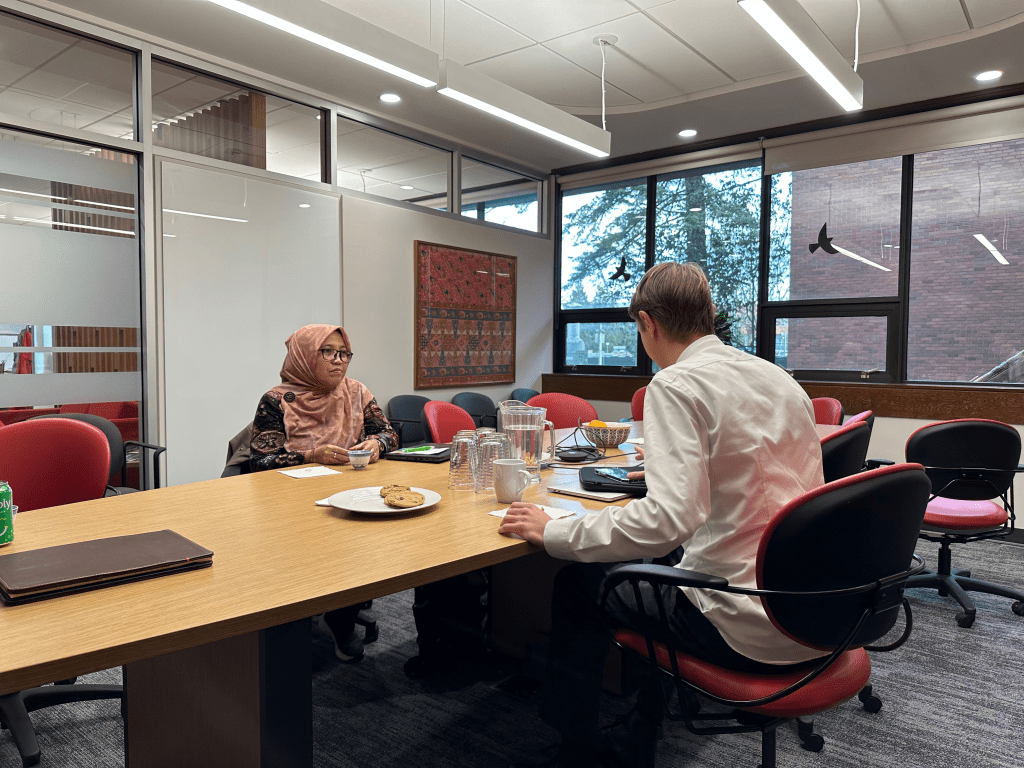
The following text presents a conversation with Dr. Yuyun Sunesti, who is an Associate Professor of Sociology of Religion and Gender in the Department of Sociology, Faculty of Social and Political Sciences, Universitas Sebelas Maret, Surakarta, Indonesia. She is currently a visiting fellow at the Department of Anthropology, College of Arts and Science, University of Saskatchewan, under the Canadian Southeast Asian Studies Initiative (CSEASI) Fellowship Program. On November 18, Dr. Yuyun Sunesti visited the Center for Asia-Pacific Initiative (CAPI) at the University of Victoria to present her preliminary research findings on the Indonesian Muslim community in Saskatoon, Saskatchewan. Yuri Frolov, CSEASI’s social media creator, spoke with her about Canada-Indonesia connections, her experiences in Saskatoon, the life of the Indonesian community in North America, and her research conducted in both Canada and Indonesia.
YF: Thank you so much for coming to Victoria today. I’d like to ask you about your research, both here in Canada and in Indonesia, as well as your general impressions of our country. To start, how did you enjoy your time in Canada? What was Saskatoon like?
YS: Thank you for having me. I really like Canada! It’s very different from Indonesia, especially the weather. When I arrived in September, it was such a shock—I’d left Indonesia where it was 41°C, and when I got here, it was 11°C. It felt freezing! The weather here takes some getting used to, especially in Saskatoon. Winters can be extreme, with temperatures like -10°C or -12°C. For someone coming from Indonesia, that’s difficult to adjust to. But apart from the weather, I enjoy everything about Canada. The cities are much tidier and more orderly compared to Indonesia, where things can be crowded and polluted. The food here is also easy for me to adapt to, and I even like Canadian-style cuisine. Overall, I’ve really appreciated my time here.

YF: Could you tell me more about your research in Indonesia? What are your primary areas of focus?
YS: Of course. My research primarily revolves around religious issues and gender in Indonesia. I’ve explored various topics, but my most recent work, which is part of my dissertation, focuses on niqabi women—women who wear the niqab—in contemporary Indonesia. This practice became significantly more visible after the reform era started in 1998, following the fall of Suharto. The rise of the niqab in Indonesia reflects two contrasting trends. On one side, it represents a resurgence of Islam and public displays of religious identity. On the other side, it highlights Indonesia’s accommodation of democratic values and pluralism. For some, the niqab is seen as a symbol of acceptance of diversity, while for others, it raises fears about radicalism. This tension is central to my research. Another project I worked on was in Lombok, an eastern part of Indonesia. Lombok has the highest number of women-led households in the country, and I wanted to understand their experiences. I studied how these women accessed government policies and facilities, as well as how they built resilience in their daily lives.
YF: That’s fascinating. What about your research in Canada? What have you been focusing on, and what have you found so far?
YS: My research here is still in its early stages, as I’ve only been doing my research for about a month. I’m studying how Indonesian immigrants adapt to life in Canada, which is so different from life in Indonesia. Canadian society is more modern, secular, and individualistic, whereas Indonesia has a more collective culture. One of my preliminary findings is about the shift in how religion is practiced. In Indonesia, religious practices are often collective and communal. For example, people pray together, celebrate religious festivals in large groups, and religion is a very public aspect of life. But in Canada, religion becomes more private and individualized. This change affects how Indonesian immigrants maintain their faith and identity here. I’ve also observed that the community here is quite small—there are around 200 Indonesians in Saskatoon, and around 50 of them are Muslim, including children. It’s interesting to see how this small group navigates maintaining their Indonesian and Muslim identities while living in a very different cultural context.
YF: Speaking of identity, how do Indonesian immigrants and their children maintain their cultural and religious identities in Canada?
YS: That’s a big challenge, especially for the second generation. First-generation immigrants—those who moved here as adults—often make a strong effort to maintain their Indonesian and Muslim identities. They remind their children about their heritage, telling them things like, “You are Indonesian, and you are Muslim, so you must practice your religion and uphold our cultural values.” However, it’s difficult for the children. They grow up surrounded by Canadian culture, and many of their friends are non-Muslim. Some children follow their parents’ teachings, but others choose their own paths. Parents often say that once their children turn 18, they can’t control them anymore. At that point, they rely on prayer, hoping their children will continue to identify as Muslim and Indonesian. This generational dynamic highlights the tension between preserving cultural identity and adapting to a new environment.
YF: That’s really insightful. Shifting gears a bit, I’d like to ask about Indonesians’ perception of Canada. Does Canada’s global image resonate in Indonesia? Do people there distinguish between Canada and the United States?
YS: That’s an interesting and difficult question. Based on what I’ve heard from my research participants, those who have recently moved here, Canada is generally viewed positively. They see Canada as a country that values multiculturalism and respects differences in culture, religion, and ethnicity. This makes it easier for Indonesians to feel accepted and live here. However, many Indonesians in Indonesia itself are not very familiar with Canada. It’s geographically distant, and for those who have never been here, Canada and the U.S. often seem like “siblings.” People think of them as very similar. Australia, being closer to Indonesia, is much more well-known. Nonetheless, individuals with an interest in Canada hold diverse perspectives. On one hand, Canada’s reputation among many Indonesians is very good, as this country is known for promoting freedom, inclusivity, and quality of life. On the other, it’s important to note that many Indonesians have mixed feelings about Western countries in general. Some admire the freedoms and opportunities available in places like Canada, while others view these freedoms negatively, particularly from a conservative or religious standpoint.
YF: Thank you so much for sharing all of this. Your insights are incredibly valuable.
YS: Thank you!
 Canadian Southeast Asian Studies Initiative